
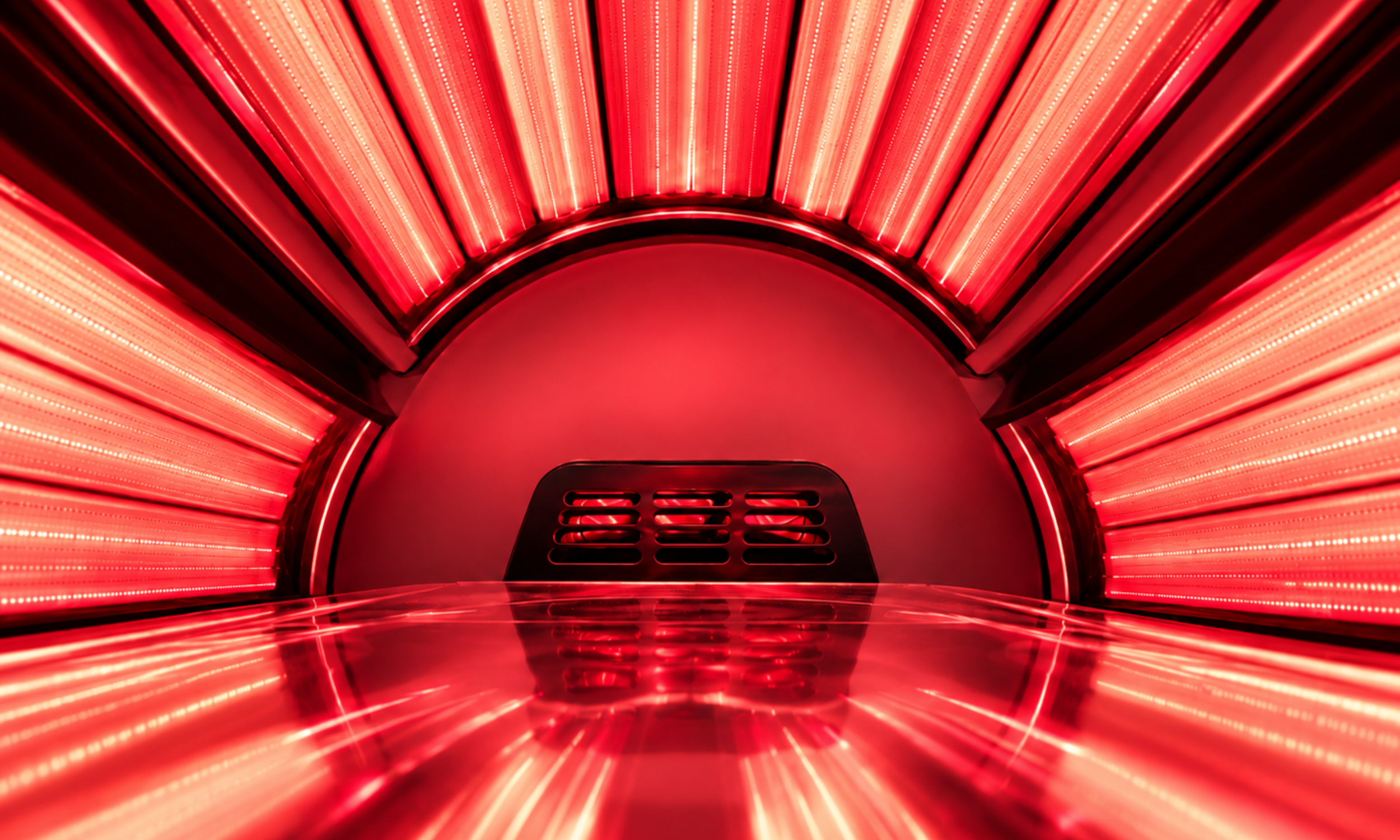
You've probably noticed the same glowing red panels showing up everywhere lately, in wellness clinics, medspas, and now your feed, and you're wondering if any of it is real or just another wellness trend with good lighting.
That's a fair question, and it deserves a straight answer.
So, how does red light therapy work?
It comes down to a process called photobiomodulation, where specific wavelengths of light are absorbed by your cells and may influence how those cells function, without heat damage, without breaking the skin, and without the UV exposure you get from the sun or a tanning bed.
This guide walks through what's actually happening in your body during a session, what red light therapy may support, and what to expect from New South's LightBed before you decide if it belongs in your routine.
What Is Red Light Therapy?
Red light therapy, sometimes called low-level light therapy or photobiomodulation, uses red and near-infrared light delivered at specific wavelengths your skin and tissue can absorb.
It's a different category entirely from the treatments people usually associate with a MedSpa visit.
There's no laser resurfacing, no controlled tissue injury, and no UV light involved at all, which is part of why it doesn't come with peeling, downtime, or the kind of recovery window that follows something like CO2 resurfacing.
Instead, the light penetrates the skin at a low, non-damaging intensity and is taken up by structures inside your cells.
Photobiomodulation is the term for light triggering a biological response in cells without generating heat or injury, and it's the mechanism behind everything red light therapy is used for, from skin support to recovery.
How Light Interacts With Your Body
Here's where it gets specific, and where a lot of marketing gets vague on purpose.
When red and near-infrared light reaches your cells, it's absorbed by mitochondria, the structures responsible for producing cellular energy.
That absorption may support the mitochondria's ability to generate energy more efficiently, which is the starting point for most of what red light therapy is associated with.
More available cellular energy can support the processes your body already uses for repair and maintenance.
It doesn't introduce something foreign or synthetic.
Light exposure at these wavelengths has also been studied for its relationship to local circulation and inflammation signaling.
Improved blood flow to the treated area may help deliver oxygen and nutrients where they're needed, and there's ongoing research into how light therapy interacts with the signaling pathways involved in inflammation and tissue recovery.
What red light therapy is not is a cure-all, and it won't work identically for every person.
Your baseline health, the consistency of use, and what else you're doing for recovery and skin health all shape the result.
Anyone promising the same outcome for everyone isn't being straight with you.
What Red Light Therapy May Support
Based on how photobiomodulation works, red light therapy is commonly used to support a few specific areas.
These are wellness benefits, not treatment or cure claims, and results vary by individual.
Skin health. Light exposure at these wavelengths is associated with supporting the skin's own collagen production process and overall tone, which is why full body red light therapy has become popular alongside more targeted skin treatments.
Recovery. Many people use red light therapy after exercise or physical strain, pairing it with rest and hydration as part of a broader recovery routine.
Circulation. Supporting local blood flow is one of the more consistently discussed effects of light therapy across the wellness and sports recovery space.
Relaxation. Beyond the physiological effects, a LightBed session is simply restful. Lying still for a set period, away from screens and stimulation, has value on its own.
None of this replaces medical treatment for a diagnosed condition, and none of it is guaranteed.
It's a supportive tool, not a substitute for the rest of your health picture.
What a LightBed Session at New South Is Actually Like
If you've never done full body red light therapy, the format is simple.
You lie comfortably inside the LightBed while targeted light is delivered across a large surface area at once, rather than to one small spot the way older, handheld red light devices work.
There are no needles, no numbing cream, no peeling afterward, and no downtime built into your day.
You get dressed, you go about the rest of your life.
What's different about doing this at New South is what happens around the session, not just during it.
We're the only practice in the Fort Mill and Charlotte area that brings physician-led primary care, BHRT, integrative functional testing, a structured wellness program, and medical-grade aesthetics together under one roof, with one chart and one care team behind every recommendation.
If your LightBed session is part of a bigger conversation about your skin, your hormones, or your recovery from training, that context is already sitting in front of your provider.
You're not explaining yourself from scratch every time you walk in.
Is Red Light Therapy Safe?
For most healthy adults, red light therapy is considered low-risk because it doesn't use UV light and doesn't create the kind of tissue injury associated with resurfacing or ablative treatments.
That said, "low-risk" isn't the same as "right for everyone."
Certain medications, skin conditions, and pregnancy are reasons to talk it through with a provider first rather than assume.
This is exactly why New South treats LightBed as part of a real consultation, not a walk-up service.
Frequently Asked Questions
-
Red and near-infrared light is absorbed by your cells, primarily by the mitochondria, which may support cellular energy production, local circulation, and the body's natural recovery and inflammation signaling processes. It doesn't use UV light or create tissue injury the way resurfacing treatments do.
-
It's commonly associated with supporting the skin's own collagen production and overall tone over time. It works differently than treatments like microneedling or laser resurfacing, since there's no controlled injury involved, just light exposure at specific wavelengths.
-
For most healthy adults, yes, since it avoids UV exposure and doesn't damage tissue. Certain medications, skin conditions, or pregnancy are reasons to check with a provider first, which is part of why New South treats it as a guided service rather than a self-serve one.
-
LightBed delivers light across a large surface area at once, so your whole body is exposed in a single session rather than treating one small area at a time with a handheld device.
-
There's no universal number. Frequency depends on your goals, whether you're focused on skin, recovery, or circulation, and what else is part of your routine. This is why it's treated as a repeated practice, not a one-time fix.
-
LightBed is bookable as a standalone service at New South. It's also available as an add-on for our Essentials and Advanced Bank Your Beauty members and 2 complimentary sessions per month for Elite members.
The Bottom Line
Red light therapy isn't magic, and it isn't nothing either. It's a supportive tool grounded in how your cells actually respond to specific wavelengths of light, and it works best as part of a routine you stick with, not a one-time try.
